
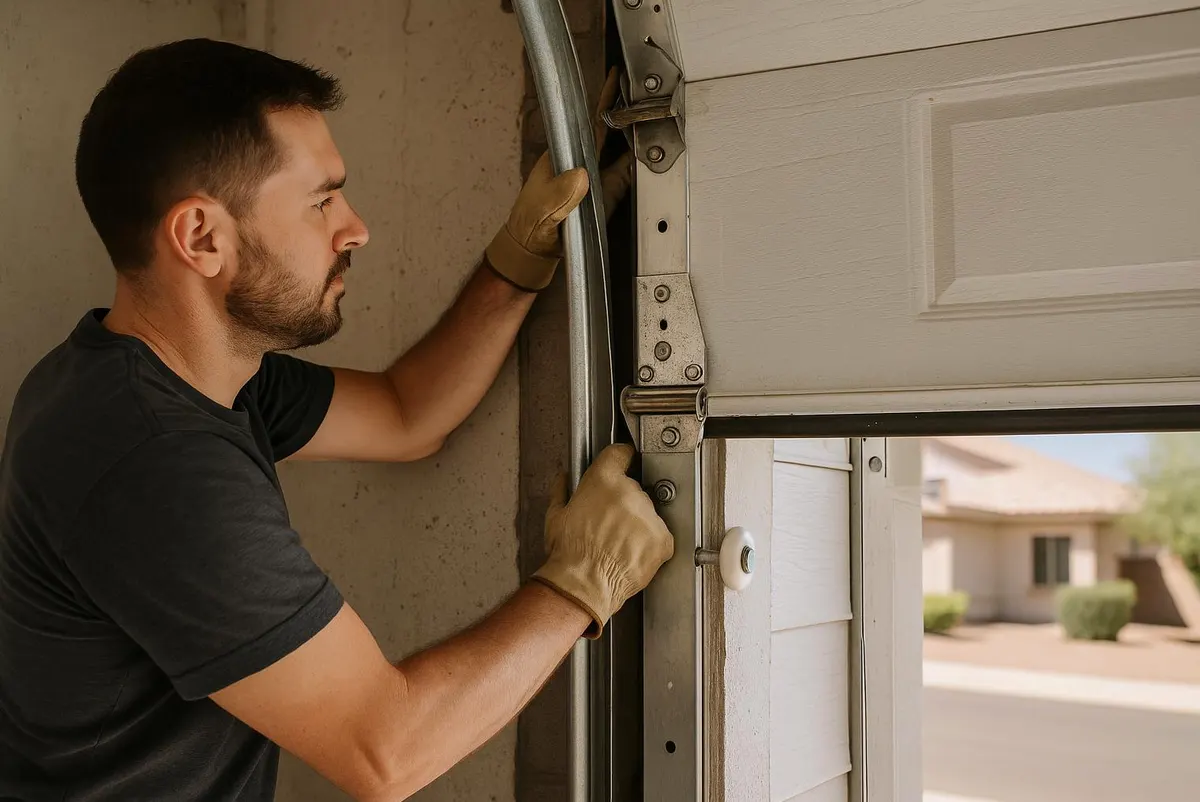
The short answer
You almost certainly don't need to rip out a garage door just because it's older than your kids. A handful of specific parts on pre-1993 doors are real safety hazards and worth upgrading. Everything else — the heavy steel or wood panel itself, a properly sized torsion spring, a manual release you actually understand — is a matter of preference, not danger. Print this out and settle the argument.
What's genuinely unsafe and worth fixing
Federal rules requiring auto-reverse technology on residential garage door openers didn't take effect until 1993. If your opener predates that, or was swapped in secondhand without anyone checking, it may not stop or reverse when something is underneath the door. That's not a nice-to-have, that's the whole point of the mechanism.
- No photo-eye sensors: those two small boxes mounted a few inches off the floor on either side of the track. If they're missing entirely, the door has no way to detect a kid, pet, or car bumper in its path.
- No auto-reverse on contact: set a 2x4 flat on the ground where the door closes. If the door doesn't stop and reverse within a couple seconds of touching it, the opener needs to be replaced, not patched.
- Fixed-code remotes: older openers broadcast the same signal every time, which can be captured and replayed by a basic code-grabbing device. Rolling-code openers change the signal with every use.
- Frayed lift cables or visibly rusted spring coils: these carry serious tension and don't give much warning before they fail. Age plus Texas humidity swings and summer heat accelerates wear on both.
None of these fixes require a new door. A modern opener with photo eyes and rolling code can be installed on an old, perfectly solid door panel. That's usually the cheapest way to close the real safety gap without a full replacement.
What's fine to leave alone
A heavy steel or solid wood door from the 90s that still opens smoothly, isn't rusted through, and isn't warping is not a liability by itself. Plenty of older doors are better built — thicker gauge steel, solid wood rather than laminate — than some budget doors sold today. If it's not insulated, that affects your energy bill in a long Texas summer, not your safety.
A manual torsion spring system is also fine to keep, provided the spring is correctly sized for the door's weight and hasn't been patched or re-wound by someone guessing. The spring itself isn't an outdated technology; it's the same system used today. What matters is condition, not vintage.
And if your household disagreement is really about looks — a dated panel style or faded paint — that's an aesthetic call, not a safety one. Repaint it, add new hardware, or just accept it's not winning any curb-appeal awards. None of that is dangerous.
Why local weather makes this more than a theoretical argument
North Texas puts real stress on older hardware. Long, hot summers dry out and crack weatherstripping, and the metal track and spring coils expand and contract with the heat, speeding up fatigue on parts that are already decades old. Sudden severe storms bring wind-driven hail and debris that can dent panels or knock a door off-balance, which is exactly when a worn cable or an opener without auto-reverse becomes dangerous instead of just annoying. Dust and grit also work their way into old rollers and hinges faster here than in milder climates, so lubrication and a hardware check matter more than they would somewhere drier or cooler.
When to call Haltom City Garage Door
If you're not sure whether your opener actually auto-reverses, if the photo eyes are missing or blinking oddly, or if you can see rust pitting on the spring coils, that's worth a visit rather than a guess. We handle Garage Door Opener Installation for homes still running pre-1993 openers, swapping in a modern unit with photo eyes and rolling code without touching a door panel that's otherwise in good shape. We also do straightforward Garage Door Maintenance visits — checking cables, spring tension, rollers, and alignment — so you know which parts of an older setup are safe to keep and which ones are on borrowed time.
If you're in Haltom City, Fort Worth, North Richland Hills, Richland Hills, Watauga, Saginaw, Keller, or Colleyville and want a straight answer on your door instead of a guess, call Haltom City Garage Door. We'll tell you what actually needs fixing and what can wait.