
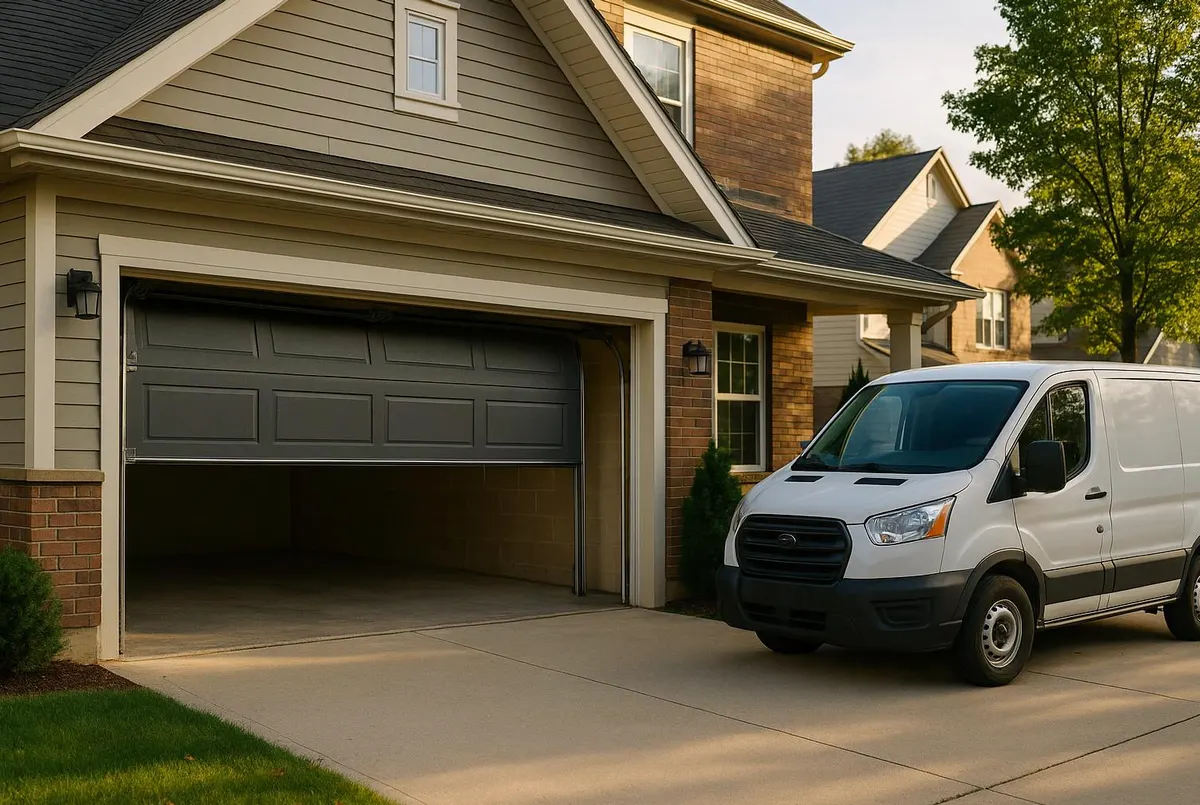
A call comes in about a door on a detached shop behind a house near Airport Freeway — somebody's running a small welding business or storing a fleet of work trucks back there. The door is a standard residential one, installed years ago because it was cheaper, and now it's sagging in the middle, the opener is straining, and the springs are wearing out every few months instead of every few years. The homeowner and the person running the business out back have been arguing about whether that's normal. It isn't. That door was never built for the job it's doing, and this is usually the moment a technician gets to explain why.
It's Not Just a Bigger Garage Door
A residential garage door is engineered around a simple assumption: it opens and closes a handful of times a day, mostly by one household. Commercial and warehouse doors are built around a completely different assumption — dozens of cycles a day, heavier loads, wider spans, and in a lot of warehouse settings, forklifts or loading equipment nearby.
- Steel gauge: Commercial doors use thicker steel sections to resist dents from equipment, pallets, and daily bumps that a house door never sees.
- Spring systems: Residential torsion springs are rated for a certain number of cycles before they wear out. Commercial doors use higher-cycle springs, and often two torsion springs instead of one, because the door is opening far more often.
- Track and hardware: Wider doors need heavier tracks, more rollers, and reinforced struts to keep a 12- or 14-foot-wide door from racking or binding.
- Openers: A residential opener is sized in fractions of horsepower for light, occasional use. Commercial openers are built for continuous duty and heavier doors, and many run on three-phase power in true warehouse settings.
Why This Matters in North Texas
Long, hot summers push commercial-grade openers and doors harder than they push a residential setup — more cycles means more heat buildup in motors and more wear on nylon rollers that aren't rated for it. Sudden hail and wind events are common here too, and a lighter residential-gauge door on a shop or small warehouse is far more likely to dent or buckle under wind load than a door actually built to commercial wind-load standards. Add in the dust that blows around open lots and gravel drives in this part of Tarrant County, and you get grit working its way into tracks and hinges faster on a door that's cycling all day long.
Maintenance Looks Different Too
A homeowner might get away with checking their garage door once or twice a year. A commercial door earning its keep every day needs a tighter schedule:
- Monthly visual checks on cables, rollers, and the bottom seal for wear or damage.
- More frequent lubrication of hinges, rollers, and torsion springs, since dust and heat accelerate wear.
- Photo-eye sensor alignment checks — these get bumped often in busy shop environments.
- Periodic inspection of the opener's gears and chain or belt, especially if the door is cycling dozens of times a day.
Skipping this on a commercial door doesn't just mean an inconvenient squeak — it means a door that can fail mid-shift, which is a bigger problem when there's a business depending on it.
So Who Wins the Argument?
If there's a business, a workshop, or regular heavy use happening behind that door, it's not overkill to install actual commercial-grade equipment — it's the cheaper option long-term. A residential door forced into commercial duty will keep failing, and keep costing money in repeated spring and roller replacements.
When to Call Haltom City Garage Door
If a door at a shop, small warehouse, or business property in Haltom City, Fort Worth, North Richland Hills, or anywhere else in our service area is cycling heavily or showing the kind of wear described here, it's worth having it looked at before something fails during business hours. We install and service Commercial Garage Doors built for the cycle counts and loads this climate and this kind of use demand, and we offer Garage Door Maintenance plans scaled to how often a door is actually being used, not just a once-a-year checkup.
Call Haltom City Garage Door today to get your commercial or warehouse door built — and maintained — for the job it's actually doing.